There are a handful of issues you’ll probably encounter eventually. The good news is that most of them are fairly easy to diagnose. I answer a lot of airbrush-related questions at work. One thing I’ve learned is that most problems people experience with their airbrushes can be solved with a good cleaning. People are often surprised when I show them the results. Airbrushes are precise tools, and nobody automatically knows how to maintain one the first time they pick it up.
Learning how to clean the tool is part of learning how to use it. Once you develop good maintenance habits, troubleshooting becomes much easier.
Paint Spatter
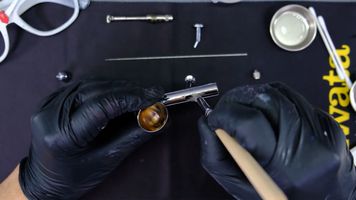
Paint spatter is one of the most common airbrushing problems. If your airbrush suddenly starts producing inconsistent dots or larger droplets of paint, the nozzle may be partially clogged. This is especially common with water-soluble acrylics because they dry quickly and can form semi-cured clumps. Start by emptying and cleaning the colour cup. If the problem continues, clean the nozzle and front end of the airbrush as you would during a full disassembly. A clean nozzle should restore a consistent spray pattern.
Constant Airflow
If air continues flowing even when you aren’t touching the trigger, the air valve is probably sticking. Paint or cleaner may have worked its way into the valve assembly, or the mechanism itself may simply need cleaning or lubrication. Paint should normally remain around the colour cup, paint channel and nozzle area. However, because the needle moves through the body of the airbrush, contamination can occasionally travel farther backwards than intended. If the trigger isn’t shutting off the airflow properly, inspect and clean the air valve mechanism.
No Airflow
If no air comes out at all, listen carefully when you press the trigger. If you can hear air hissing inside the airbrush but nothing is reaching the front, you may have a blockage somewhere between the air valve and nozzle. If you hear nothing, the problem may be in the air valve itself, compressor connection or another part of the air supply. Check your hose connections first. I know it seems obvious, but proveably ruling out the obvious is the best way to begin troubleshooting. If those are fine, clean and inspect the airbrush.
Stuck Components
Everything on a properly maintained airbrush should move smoothly. The trigger should move freely. The needle should slide without excessive resistance. Caps and threaded components should unscrew without needing excessive force. If something that normally moves freely suddenly feels stuck, dried paint is probably involved. Do not force delicate components. Clean the area instead. A stuck nozzle, needle or needle chuck can be damaged very easily if you simply try to overpower it.
Tip Dry
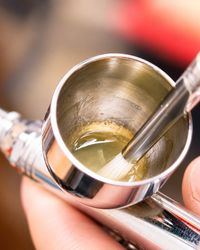
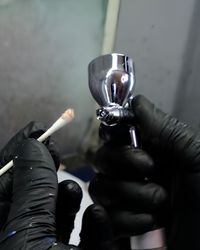
Tip dry happens when paint begins drying on the exposed tip of the needle. This is particularly common with water-soluble acrylics. You may notice your spray pattern becoming inconsistent, the paint beginning to spatter, or the airbrush gradually becoming less responsive. Fortunately, this is usually easy to fix. Put a little of the appropriate cleaner or thinner on a cotton swab and very gently wipe the dried paint from the needle tip and inside the nozzle cap. Be careful around the needle. It is extremely easy to bend the very tip if you catch it with the cotton swab or wipe too aggressively. Once the dried paint is gone, your spray pattern should return to normal.